

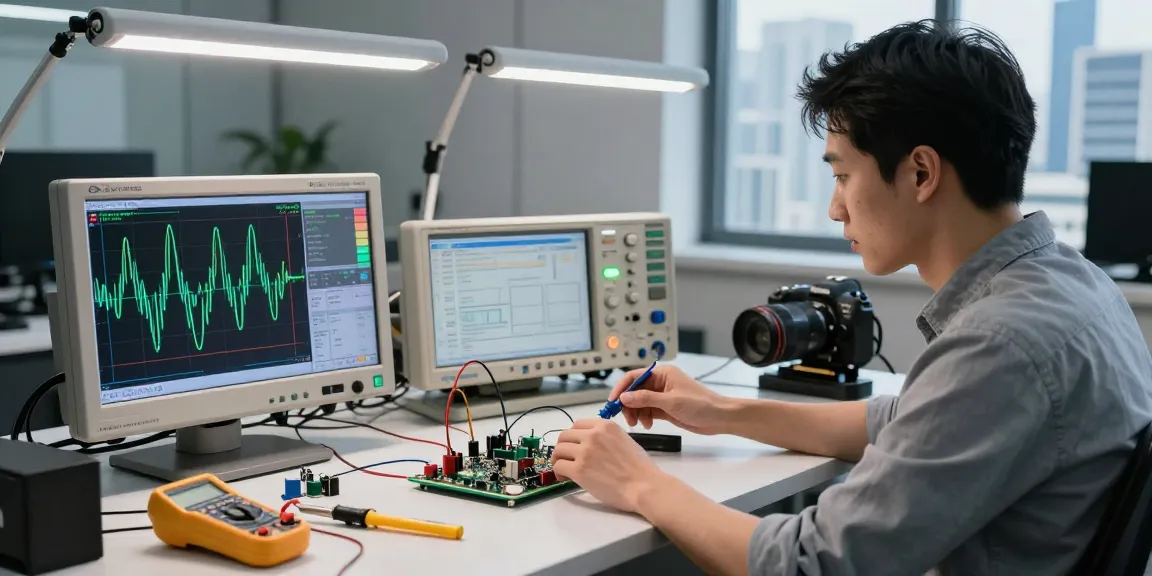
Understanding the 2 Channel Digital Oscilloscope
The 2 Channel Digital Oscilloscope is a versatile tool that has become essential for both professionals and hobbyists engaged in electronics and signal analysis. Unlike traditional oscilloscopes, digital versions provide enhanced capabilities for capturing, analyzing, and displaying electrical signals in real-time. Whether you are troubleshooting complex circuits or conducting routine testing in a lab, these oscilloscopes facilitate advanced measurement techniques. When exploring options, 2 Channel Digital Oscilloscope models offer a range of features tailored for accuracy and ease of use across various applications.
What is a 2 Channel Digital Oscilloscope?
A 2 Channel Digital Oscilloscope is an electronic test instrument that graphically displays voltage signals as a function of time. The ability to observe two signals simultaneously makes these oscilloscopes particularly valuable in applications where comparing different signal characteristics is critical. This dual-channel feature allows for comprehensive analysis, enabling users to visualize interactions, phase differences, and amplitude variations between electrical signals.
Key Features and Specifications
- Bandwidth: The bandwidth of an oscilloscope is critical as it determines the range of frequencies it can accurately measure. Typical 2 channel models, such as the HANMATEK® DOS1102, offer bandwidths of 110MHz or higher, ensuring that even high-frequency signals can be accurately represented.
- Sampling Rate: This specification measures how often the oscilloscope samples a signal, with rates typically ranging from 250MSa/s to 2GSa/s. A higher sampling rate allows for more precise signal representation and is essential for capturing fast transients.
- Memory Depth: The depth of memory affects how long the oscilloscope can record data. Models like the HANMATEK® DOS1202 can store up to 10 million data points, allowing for extensive waveform capture without risking data loss.
- Display: Many modern digital oscilloscopes feature high-resolution displays with touch capabilities, providing an intuitive user interface for navigation and signal analysis.
Applications Across Industries
2 Channel Digital Oscilloscopes find applications across various fields, including:
- Electronics Design: Engineers use oscilloscopes to validate circuit designs and troubleshoot issues through detailed waveform analysis.
- Automotive Testing: In the automotive industry, these tools are crucial for diagnosing issues with complex electronic systems in vehicles.
- Education: Educational institutions utilize oscilloscopes for teaching electronic principles, allowing students hands-on experience with real-world applications.
- Telecommunications: Engineers in telecommunications rely on oscilloscopes to test and analyze radio frequency signals and other communication systems.
Benefits of Using a 2 Channel Digital Oscilloscope
Improved Signal Analysis and Accuracy
Utilizing a 2 Channel Digital Oscilloscope dramatically enhances the precision of signal analysis. By providing real-time waveform visualization, users can instantly observe changes in signal characteristics, ensuring swift identification of anomalies. This immediate feedback is vital in preventing faulty designs and reducing iteration cycles in product development.
Enhanced User Experience and Functionality
Modern oscilloscopes incorporate user-friendly interfaces, often featuring touchscreens for easier navigation. Additionally, many models allow for advanced functionalities such as automated measurements, FFT analysis, and extensive triggering options that make setup and experimentation simpler for users across all skill levels. With built-in connectivity options like USB and Wi-Fi, sharing data and collaborating has never been easier.
Cost-Effectiveness for Hobbyists and Professionals
For both hobbyists and professionals, 2 Channel Digital Oscilloscopes provide an excellent balance of cost and functionality. Models such as the HANMATEK® HO52 2-in-1 Handheld Oscilloscope enable users to perform high-quality analyses without breaking the bank, making sophisticated tools accessible to various audiences.
Choosing the Right 2 Channel Digital Oscilloscope
Factors to Consider: Bandwidth and Sampling Rate
When selecting an oscilloscope, it is imperative to consider both the bandwidth and the sampling rate. A general rule is to choose a bandwidth that is at least five times the maximum frequency you plan to measure. Similarly, a higher sampling rate often results in more accurate representation of the waveform, minimizing the risk of missing fast signal components.
Comparing Popular Models in 2026
As of 2026, several models of 2 Channel Digital Oscilloscopes stand out in the marketplace:
- HANMATEK® DOS1102: With a bandwidth of 110MHz and a 1GSa/s sampling rate, it is ideal for general-purpose applications.
- HANMATEK® DOS1202: A more advanced model featuring a 200MHz bandwidth, suitable for professional use in demanding environments.
- HANMATEK® HO52: This portable option combines oscilloscope and multimeter functionalities, making it versatile for fieldwork.
Understanding User Reviews and Experiences
User feedback plays a crucial role in identifying the right oscilloscope for your needs. Reviews often highlight factors such as user-friendliness, reliability in different testing scenarios, and the quality of customer support. Engaging with a community through forums or dedicated groups can provide valuable insights into the practical performance of specific models.
Common Challenges and Misconceptions
Debunking Myths About Digital Oscilloscopes
One common misconception is that analog oscilloscopes are inherently superior to digital versions. However, digital oscilloscopes offer capabilities such as advanced triggering, analysis features, and storage functions that analog counterparts lack. As the technology has evolved, the gap between digital and analog performance has narrowed significantly.
Addressing Common User Issues
Users may sometimes experience challenges such as improper trigger settings or incorrect probe configuration which can lead to misleading waveforms. Understanding the manuals and taking advantage of online tutorials can significantly minimize these issues and improve overall user competency with the device.
Best Practices for Optimal Usage
- Regular Calibration: Ensure your oscilloscope is calibrated to maintain signal accuracy.
- Utilize Probes Correctly: Use appropriate probes for your measurement needs to enhance accuracy.
- Familiarize with Features: Take time to explore all features and functions available on your oscilloscope to maximize its potential.
The Future of Digital Oscilloscope Technology
Emerging Trends in 2026 and Beyond
As technology advances, the capabilities of digital oscilloscopes are expected to expand significantly. Future models may incorporate more sophisticated algorithms for signal processing, enhanced machine learning capabilities for predictive analysis, and even better integration with mobile applications for remote monitoring.
Predictions for Oscilloscope Innovations
Manufacturers are increasingly focusing on miniaturization and portability without sacrificing performance. The demand for handheld oscilloscopes that maintain high accuracy will likely continue to grow, making them indispensable tools in fields such as automotive diagnostics and electronics education.
Impact of Technology Advancements on User Experience
With the integration of artificial intelligence and more user-centric designs, the user experience is set to improve drastically. Future oscilloscopes may offer even more automated troubleshooting features, making them accessible for those new to electronics while providing in-depth analysis for experienced professionals.
What is the main advantage of a 2 channel oscilloscope?
The primary advantage of a 2 channel oscilloscope is its ability to visualize and compare two signals simultaneously, which is invaluable for detecting phase differences, signal interactions, and more complex behaviors in circuits.
Are there any limitations with 2 channel oscilloscopes?
While 2 channel oscilloscopes are versatile, they may not suffice for highly complex testing scenarios where multiple signal interactions are present. In such cases, a 4-channel oscilloscope might be necessary.
How do I choose the best 2 channel digital oscilloscope for my needs?
Consider your specific application requirements, including bandwidth, sample rate, and additional features such as triggers and analysis functions. Align your choice with your budget and intended usage to ensure you select the best tool for your tasks.
What should I look for in oscilloscopes for automotive testing?
For automotive testing, ensure the oscilloscope can handle the required bandwidth, has good triggering capabilities for transient voltage events, and offers portability if field testing is needed.
Can a digital oscilloscope be used for educational purposes?
Absolutely! Digital oscilloscopes are widely used in educational settings to teach students about electronics and signal analysis, providing hands-on experience with modern technology in a classroom environment.